Who this is for: anyone who saw “Oracle AI Database 26ai” announced, assumed it meant another 19c-to-23ai style upgrade project, and started dreading the regression testing calendar.
Our infrastructure manager pinged me in October asking for a rough project plan and headcount estimate for “the 26ai upgrade,” the same way we’d scoped our 19c to 23ai move two years earlier: a test environment build, weeks of application regression testing, a recertification pass with the vendor of our ERP system, a cutover weekend. I opened the release notes expecting to confirm that estimate. Instead I found out we didn’t need a project at all. If you’re already running Oracle Database 23ai, moving to Oracle AI Database 26ai is a quarterly patch, not an upgrade.
Why This Matters
At Oracle AI World in October 2025, Larry Ellison announced that Oracle AI Database 26ai replaces Oracle Database 23ai. That word “replaces” is doing a lot of work, and it’s easy to misread it as a rebrand plus a version bump, the kind of thing that normally comes with a new internal architecture, changed APIs, and a recertification cycle for anything sitting on top of the database. That’s not what happened here. Oracle’s engineering team added a large wave of AI capability (vector search enhancements, agentic AI features, optimizer and management improvements) on top of the existing 23ai codebase without touching the internal architecture or existing APIs. The database underneath is still, structurally, 23ai.
That distinction is why Oracle can say there’s no need for a complex database upgrade or an application recertification cycle to get onto 26ai if you’re already on 23ai. It also explains a change that trips people up: the version numbering scheme changed specifically to make this relationship visible.
Reading the new version numbers
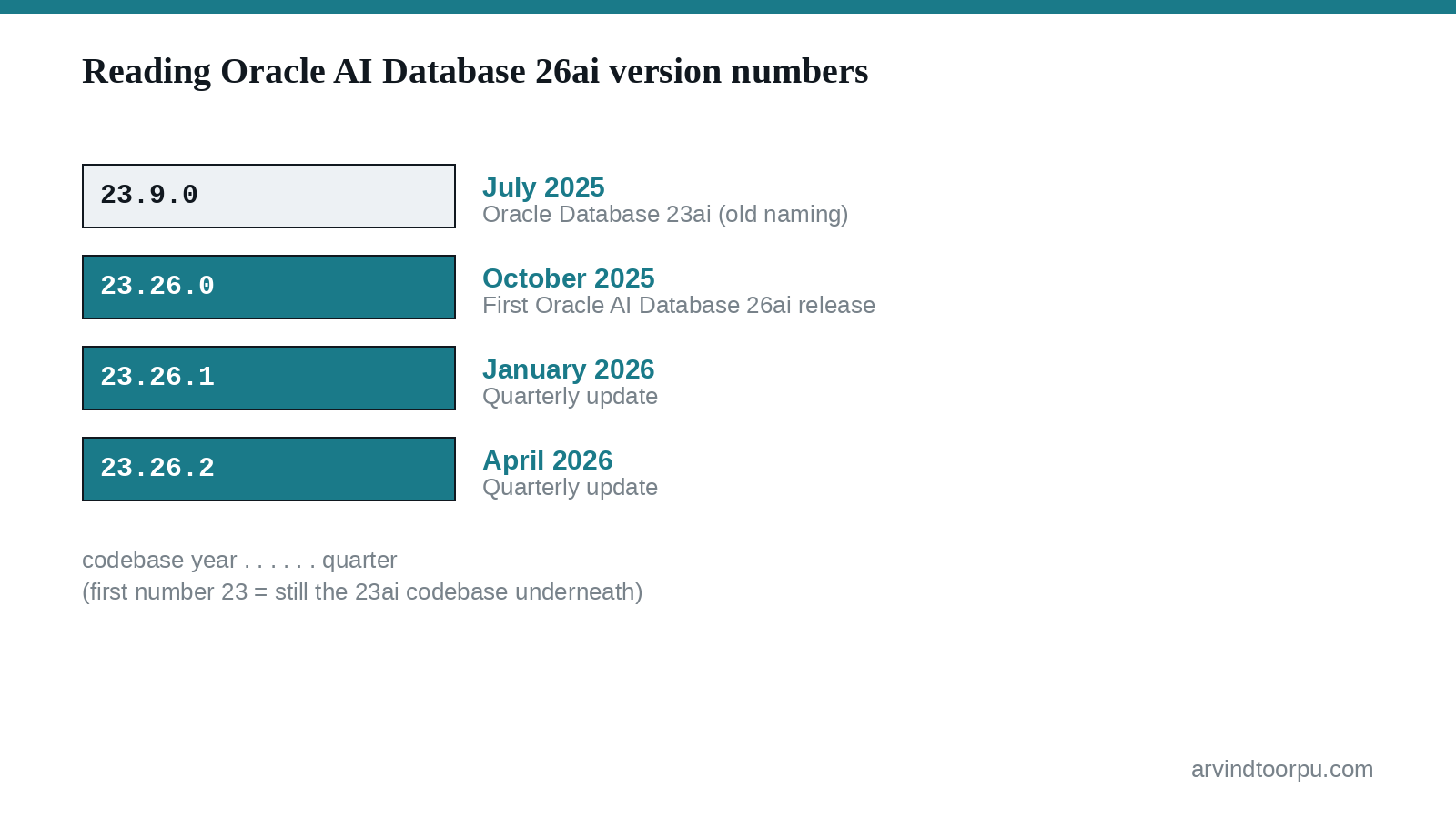
The first number in the release stays “23,” because Oracle AI Database 26ai is still built on the Oracle Database 23ai codebase. The second number is the calendar year of the release update, and the third is the quarter. Once you know that, the version string tells you exactly when a release shipped:
23.9.0, July 2025: the last Oracle Database 23ai quarterly release under the old naming.23.26.0, October 2025: the first Oracle AI Database 26ai release update.23.26.1, January 2026: the next quarterly update.23.26.2, April 2026: the update after that.
The “0” quarter on the October 2025 release looks odd because there is no quarter zero; Oracle just needed to cut over to the new scheme in time for the Oracle AI World announcement rather than waiting for an actual Q1. Once you see a few of these version strings side by side, the pattern is easy to read without looking anything up.
What you actually need to do
The path onto 26ai depends entirely on what you’re running today:
- On Oracle Database 23ai already: apply the October 2025 quarterly Release Update (23.26.0) or any later quarterly RU, using whatever patching tooling you already use (AutoUpgrade, opatchauto, your own scripts). There is no database upgrade step and no application recertification. If you’re on Real Application Clusters, you can apply it in a rolling fashion exactly like any other quarterly RU.
- On Oracle Database 19c or 21c: you upgrade directly to Oracle AI Database 26ai. There’s no requirement to land on 23ai first as an intermediate step.
- On anything older than 19c (12c, 18c, and earlier): you still need to get to a supported starting point (19c or 21c) before jumping to 26ai; the direct-upgrade shortcut only applies from 19c or 21c.
- On Oracle Autonomous Database running 23ai: there’s nothing to do. Autonomous 23ai databases were automatically updated to 26ai Autonomous AI Database.
Because Oracle Database 23ai was designated a Long Term Support release, that same Long Term Support policy carries over to Oracle AI Database 26ai automatically, since 26ai is presented as a continuation of the 23ai codebase rather than a new release starting its own support clock.
Where This Requires Care
“No upgrade needed” is a statement about the database architecture and API surface, not a guarantee that nothing will behave differently. This single release update ships with a genuinely large number of new features (priority transactions and automatic transaction rollback, automatic transaction quarantine, hybrid vector search changes, and a long list of others), and some of them change default behavior or introduce new automatic actions inside the database. Treat this like you would any quarterly RU that happens to be unusually large: read the new features and deprecated features documentation for the specific version you’re moving to, and test in a non-production environment before rolling it out, even though the upgrade mechanics themselves are simple.
Platform availability also isn’t uniform. Oracle AI Database 26ai went generally available first on Oracle Cloud Infrastructure, Azure, Google Cloud, and AWS, and on-premises on engineered systems like Exadata and the Oracle Database Appliance, plus Oracle Database Free for developers. Broader on-premises platform availability rolled out afterward on its own timeline. Check the specific platform and OS combination you run before assuming the October RU is already available to you.
And don’t let “just apply the RU” become an excuse to skip your normal patching discipline. Read the deprecated features list for the version, since Oracle does retire things even inside what’s messaged as a low-friction update, and confirm nothing your application depends on is on that list.
Quick Reference
- Oracle AI Database 26ai replaces Oracle Database 23ai as a branding and release-update change, not a new major version; the internal architecture and APIs are unchanged.
- New version numbering: first number stays 23 (the underlying codebase), second number is the calendar year, third number is the quarter. October 2025 was 23.26.0, January 2026 was 23.26.1, April 2026 was 23.26.2.
- Already on 23ai: apply the relevant quarterly RU, no upgrade or recertification, rolling-compatible on RAC.
- On 19c or 21c: upgrade straight to 26ai, no need to land on 23ai first. Older than 19c: get to 19c or 21c first.
- Autonomous Database on 23ai was auto-updated to 26ai already; there’s nothing to do there.
- The Long Term Support designation for 23ai carries over to 26ai automatically.
- Still read the new-features and deprecated-features docs and test before rolling out broadly; a simple patching mechanism doesn’t mean zero behavior change.
My Take
The renaming was, honestly, the part that caused the most confusion on our team, not the technical substance. “26ai” reads like a new major version to anyone who’s lived through a real Oracle upgrade cycle, and Oracle’s own messaging leans into that a little for marketing reasons while the fine print says otherwise. Once I explained the version numbering scheme to our manager and pointed at the “apply the RU, no recertification” language directly from Oracle, the imaginary project plan turned into a normal quarterly patching cycle with some extra testing for the transaction-management and vector search features we actually wanted to use. If you’re planning capacity or headcount around a “26ai upgrade” and you’re already on 23ai, it’s worth checking whether that plan should really just be your existing patch cadence with a longer test pass this one time.


